Showing posts with label Lord's Supper. Show all posts

Saturday, March 23, 2024

Communion for the Believer: Past, Present and Future


God’s Triune nature, reflected in triplets of Scripture, is echoed in the Lord’s Supper (Matthew 26:17-30; Mark 14:12-21; Luke 22:7-30). For Jesus, His apostles, and born-again believers, this sacrament remembers the past, celebrates the present, and expresses our sure hope for the future.

Thanks to Christ’s completed work on the cross, all of us who trust in His death, burial and resurrection (1 Corinthians 15:1-4) as the only Way to Heaven (John 14:6) have eternal life with Him. We are saved by His grace through our faith, not by works (Ephesians 2:8-9). So taking part in communion, like being baptized or joining a church, can’t save us.

Why, then do we celebrate the Lord’s Supper? Because He commanded us to -- to remember His sacrifice, to fellowship with Him and one another, and to look forward to His Second Coming. Paul summarizes how Christ told us to do this (1 Corinthians 11 17-34): in a spirit of truth (v. 17-19), sharing (v. 20-22), and self-examination (v. 27-32). He warned the church to address division (v. 18), heresy (v. 19), and revelry (v. 21-22) before they could take part in this sacrament, so that they would not receive the judgments of weakness, sickness or even death (v. 29-32).

Paul heard directly from Jesus about the Lord’s Supper and its significance (v. 23-26), because he was not present at that meal; he told it to the church at Corinth; and thanks to his first letter to Corinth being preserved in the New Testament, he also shared it with all believers thereafter. Jesus took the elements, gave thanks to the Father, and distributed the elements to the disciples.

When observing communion, we should follow Christ’s command to the disciples to take the bread, eat it, and remember that it symbolizes His body, broken for us to pay all our sin debt (v. 23-24). Similarly, He told His followers to drink from the cup, to remember each time they drank that it symbolizes the new promise of His blood washing away our sins (Matthew 26:28; Romans 3:25), and to look forward to His second coming (v. 25-26).

Communion therefore involves remembering Christ’s past, completed sacrifice for us (John 19:30; Hebrews 7:21-28); celebrating our present salvation through that sacrifice (1 Corinthians 15:1-4); and anticipating that glorious moment when we will break bread with Him in Heaven (Revelation 19:9). The three essential elements of the communion sacrament are not only the bread and the fruit of the vine, but also a cup to contain, distribute, and share the grape juice.

The cup may symbolize the cup of Jesus’ suffering, which He drank to the dregs to redeem us; our body as the earthly vessel filled at the moment of salvation by His Holy Spirit (2 Corinthians 1:22); and the sharing by all members of the body of Christ (Romans 12:5) in His blood, shed for our sins to redeem and cleanse us.

Jesus commanded all of His disciples to drink from the communion chalice with Him, acknowledging that they would drink the cup of suffering for His sake, including the baptism of martyrdom for some, but that it was up to His Father to assign specific positions of responsibility in his Kingdom (Matthew 20:22-23; Mark 10:38-39). Similarly, all born-again believers will suffer for Christ’s sake (1 Peter 4:12-19); some will be martyred; and some will receive heavenly leadership positions based on earthly service (1 Corinthians 3:10-14).

The sacrament of communion looks back to Jesus’ perfect, completed sacrifice, His broken body, and His shed blood (1 Corinthians 11: 23-25). Communion also celebrates our ongoing, present relationship with the Lord Jesus Christ. Each time we partake of the bread and fruit of the vine, whether in a church service or at our own table, we have fellowship with Him, we affirm the new covenant, and we become more like Him by assimilating His Word (John 6: 51-58).

Jesus told His followers to eat His flesh and to drink His blood, not in a literal sense as the Catholics believe in the doctrine of transubstantiation, where the wafer literally becomes His body. If that were the case, everyone who took part in communion would be guilty of crucifying Christ all over again. Thank God that when Jesus said “It is finished,” (John 19:30) it truly was! His perfect, priceless, agonizing sacrifice paid the debt in full for all our sins (John 1:29), past, present and future.

Many of Christ’s followers could not accept this saying and abandoned Him because of it. Jesus of course was not speaking of cannibalism or any other literal interpretation, but of the need for His followers to desire Him more than our daily food (Deuteronomy 8:3; Matthew 4:4); to become assimilated with Him (Romans 12:5; Galatians 3:28) by ingesting His Word as our daily bread; and to be nourished completely by Him, physically, spiritually, and eternally (John 15:5).

As born-again believers participate in a communion service or even as we break bread at our table, we commemorate what Christ did for us and thank Him that we presently are a new creation in Him (2 Corinthians 5:1). But we also anticipate with glorious hope (1 Peter 1:3) His Second Coming, when we shall experience the Rapture (1 Corinthians 15:51-53; 1 Thessalonians 4:14-17), the Judgment Seat of Christ (Romans 14:10; 2 Corinthians 5:10), and the Marriage Supper of the Lamb (Revelation 19:9), when He shall again drink the fruit of the vine with His followers (1 Corinthians 11: 26).

To partake Biblically in communion, our participation should involve not only the sacrament itself, but also the self-examination before and the worship following, which symbolizes our fellowship with Christ and His church as we hold hands in a circle, give thanks in prayer (Matthew 17:27), and praise Him in song (Matthew 17:30; Mark 14:26).

As we share in communion, may we remember how He saved us, thank Him for our abundant life with Him now (John 10:10), and look forward to eternal life with Him (John 3:16) in Heaven!

© 2015 Laurie Collett
Reposted from the archives

Saturday, March 17, 2018

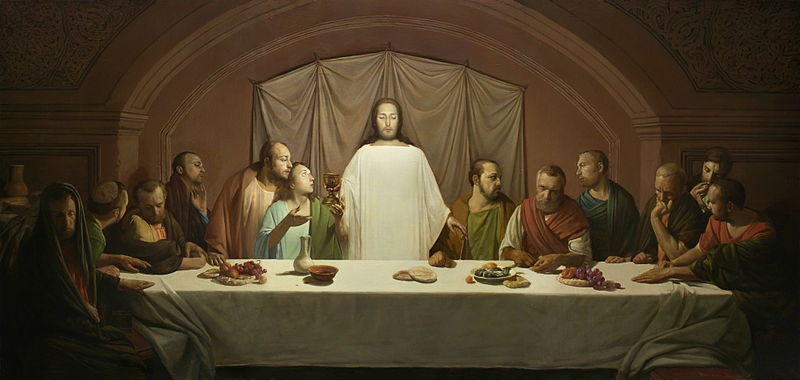
The Lord’s Supper: Before, During and After

God’s Triune nature, reflected in triplets of Scripture throughout the Bible, is echoed in the Lord’s Supper (Matthew 26:17-30; Mark 14:12-21; Luke 22:7-30). 

This memorable meal, with special significance to Jesus, to His apostles, and to born-again believers, looked back to the past, celebrated the present, and anticipated the future. 

The Lord’s Supper, convened by Jesus with His disciples the night before He was crucified, took place on the first day of the feast of unleavened bread (Matthew 26:17) during Passover. Finding the guestroom for this meal involved three people: the disciples Peter and John, and an unnamed servant (Mark 14:13-16; Luke 22:8-13). 

Jesus arranged for this supper by telling the disciples to go into the city, to meet the servant whom they would recognize by his carrying a  pitcher of water, and to ask his master to lend Jesus the large upper room for the meal (Mark 14:13). 

There are many theories about what Jesus and the twelve consumed at the meal, but Scripture only mentions bread (Mark 14:22; Matthew 26:26), fruit of the vine (Mark 14:25; Matthew 26:29; Luke 22:18), and a dip for the bread (Mark 14:20; Matthew 26:23), most likely olive oil (Exodus 29:2) containing bitter herbs (Numbers 9:11). Lamb would not be on the menu that day, as no work, such as killing, preparing, and cooking a lamb, could be done on the first day of the feast of unleavened bread (Leviticus 23:4-7).

It is fitting that the Passover lamb could not be sacrificed until the following day (Exodus 12:6), when Jesus Christ, the sacrificial Lamb Who takes away the sins of the world (John 1:29), would Himself be crucified beginning at the third hour (Mark 15:25) of the day (around 9AM), with the time of death at the ninth hour, around 3PM (Mark 15: 34).

Jesus knew the agonizing ordeal He would face in a few hours, yet He began His last meal by giving thanks (Matthew 26:27; Mark 14:23; Luke 22:17-19), emphasizing that we should thank God in all circumstances (1 Thessalonians 5:18).

He knew that He was about to be betrayed, arrested and subjected to three false trials; rejected, humiliated, and scorned by His chosen people; and beaten, crowned with thorns, and crucified. Even worse, all but John of His beloved disciples abandoned Him during this ordeal; He had to witness the heartbreak of His mother; and at the moment He took on all of mankind’s sins, God had to look away and Christ could not call Him “Father” (Matthew 27; Mark 15; Luke 23; John 19).

Jesus explained the symbolism of the Last Supper to His disciples (Matthew 26:26-28; Mark 14:22-24; Luke 22:17-20). The bread He broke represented His body that would be broken on the cross; the fruit of the vine represented His blood that would be shed to take away mankind’s sin; and all were to drink of the cup to symbolize their spiritual union with Him.

The same three products consumed at the Lord’s Supper constituted the meat and drink offering given at the feast of firstfruits, which looked forward to Jesus as the First to rise from the dead to a glorified body. The meat offering was cakes made of two tenth deals of fine flour mixed with olive oil, and the drink offering was the fourth part of an hin of wine (Leviticus 23:13).

The absence of leaven in the offering cakes, in the manna God provided to feed His children in the wilderness (Exodus 16:15,31), and in the Passover bread connotes the absence of sin (1 Corinthians 5:6-7) in Christ. He is the Bread of Life (John 6:35,48), the Bread of God (John 6:33), and the Living Bread giving eternal life (John 6:51) to all those who trust in His death, burial and resurrection (1 Corinthians 15:1-4) as the only Way to Heaven (John 14:6) .

For Jesus and His apostles, the Lord’s Supper therefore remembered God’s deliverance and acts of worship established in the past: His sparing the firstborn Hebrew children from the angel of death in Egypt (Exodus 12:12-13; 21-23); the feast of unleavened bread (Exodus 12:17; 23:15; 34:18; etc.) to commemorate the Passover, and the temple offerings at the feast of firstfruits (Leviticus 23:13).

At the first Passover, the scarlet thread of redemption by the blood was dramatically shown in the blood sacrifice of the lamb, to mark with blood the lintel and two side posts of each doorway (Exodus 12:5-7;22-23). This forerunner of the sign of the cross signified that the angel of death should “pass over” the homes thus marked, sparing the life of the firstborn within.

For all those sealed by our faith in Jesus’ shed blood on the cross, death will “pass over” us in that our physical body will die, but we will pass through the valley of the shadow of death (Psalm 23:4)., and we will live eternally with Christ (2 Corinthians 5:8). Our soul and spirit will forever be with the Lord and will ultimately inhabit our glorified body, which will never age, get sick, or die (1 Corinthians 15:35-54).

During the first Lord’s Supper, Jesus and His apostles were highly engaged in the present moment. Jesus had longed for and was now savoring His fellowship with the disciples (Luke 22:15), serving them (Matthew 26:26-27; Mark 14:22-23), and teaching them by His example, by explanation, and by warnings that they would betray, deny, or abandon Him (Matthew 26:21-24; Mark 14:18-21; Luke 22:21-34).

The disciples responded at first with self-examination, each asking with great sorrow if he was the one who would betray Christ (Matthew 26:22; Mark 14:19), but this soon degenerated into arguing over who would be the guilty one and even into jockeying for position regarding who could be considered the “best” disciple (Luke 22:23-24).

How this must have grieved Jesus, particularly on the eve of His crucifixion, and yet don’t we do the same today? We examine our own hearts all too briefly, then attempt to justify ourselves by judging sins in others and concluding wrongly that we’re better by comparison.

While remembering the past and living in the present, Jesus also used His last supper before His death to prophecy the future. He prophesied that His body would be broken and His blood shed in His crucifixion. He looked forward to the new covenant between Holy God and sinful man, reconciling them by His perfect, sinless sacrifice to pay the entire debt for all our sins (Matthew 26:28). Finally, He prophesied His coming Kingdom, when He would again eat the unleavened bread and drink the fruit of the vine in fellowship with His beloved at the Marriage Supper of the Lamb (Matthew 26:29; Luke 22:16,18).

Each time we celebrate the Lord’s Supper, we should remember Christ’s sacrifice, thank Him for our salvation, and look forward to His Second Coming! 

© 2015 Laurie Collett
Reposted from the archives


Friday, April 17, 2015

Communion for the Believer: Past, Present and Future


As we saw last week, God’s Triune nature, reflected in triplets of Scripture, is echoed in the Lord’s Supper (Matthew 26:17-30; Mark 14:12-21; Luke 22:7-30). For Jesus, His apostles, and born-again believers, this sacrament remembers the past, celebrates the present, and expresses our sure hope for the future.

Thanks to Christ’s completed work on the cross, all of us who trust in His death, burial and resurrection (1 Corinthians 15:1-4) as the only Way to Heaven (John 14:6) have eternal life with Him. We are saved by His grace through our faith, not by works (Ephesians 2:8-9). So taking part in communion, like being baptized or joining a church, can’t save us.

Why, then do we celebrate the Lord’s Supper? Because He commanded us to -- to remember His sacrifice, to fellowship with Him and one another, and to look forward to His Second Coming. Paul summarizes how Christ told us to do this (1 Corinthians 11 17-34): in a spirit of truth (v. 17-19), sharing (v. 20-22), and self-examination (v. 27-32). He warned the church to address division (v. 18), heresy (v. 19), and revelry (v. 21-22) before they could take part in this sacrament, so that they would not receive the judgments of weakness, sickness or even death (v. 29-32).

Paul heard directly from Jesus about the Lord’s Supper and its significance (v. 23-26), because he was not present at that meal; he told it to the church at Corinth; and thanks to his first letter to Corinth being preserved in the New Testament, he also shared it with all believers thereafter. Jesus took the elements, gave thanks to the Father, and distributed the elements to the disciples.

When observing communion, we should follow Christ’s command to the disciples to take the bread, eat it, and remember that it symbolizes His body, broken for us to pay all our sin debt (v. 23-24). Similarly, He told His followers to drink from the cup, to remember each time they drank that it symbolizes the new promise of His blood washing away our sins (Matthew 26:28; Romans 3:25), and to look forward to His second coming (v. 25-26).

Communion therefore involves remembering Christ’s past, completed sacrifice for us (John 19:30; Hebrews 7:21-28); celebrating our present salvation through that sacrifice (1 Corinthians 15:1-4); and anticipating that glorious moment when we will break bread with Him in Heaven (Revelation 19:9). The three essential elements of the communion sacrament are not only the bread and the fruit of the vine, but also a cup to contain, distribute, and share the grape juice.

The cup may symbolize the cup of Jesus’ suffering, which He drank to the dregs to redeem us; our body as the earthly vessel filled at the moment of salvation by His Holy Spirit (2 Corinthians 1:22); and the sharing by all members of the body of Christ (Romans 12:5) in His blood, shed for our sins to redeem and cleanse us.

Jesus commanded all of His disciples to drink from the communion chalice with Him, acknowledging that they would drink the cup of suffering for His sake, including the baptism of martyrdom for some, but that it was up to His Father to assign specific positions of responsibility in his Kingdom (Matthew 20:22-23; Mark 10:38-39). Similarly, all born-again believers will suffer for Christ’s sake (1 Peter 4:12-19); some will be martyred; and some will receive heavenly leadership positions based on earthly service (1 Corinthians 3:10-14).

The sacrament of communion looks back to Jesus’ perfect, completed sacrifice, His broken body, and His shed blood (1 Corinthians 11: 23-25). Communion also celebrates our ongoing, present relationship with Christ. Each time we partake of the bread and fruit of the vine, whether in a church service or at our own table, we have fellowship with Him, we affirm the new covenant, and we become more like Him by assimilating His Word (John 6: 51-58).

Jesus told His followers to eat His flesh and to drink His blood, not in a literal sense as the Catholics believe in the doctrine of transubstantiation, where the wafer literally becomes His body. If that were the case, everyone who took part in communion would be guilty of crucifying Christ all over again. Thank God that when Jesus said “It is finished,” (John 19:30) it truly was! His perfect, priceless, agonizing sacrifice paid the debt in full for all our sins (John 1:29), past, present and future.

Many of Christ’s followers could not accept this saying and abandoned Him because of it. Jesus of course was not speaking of cannibalism or any other literal interpretation, but of the need for His followers to desire Him more than our daily food (Deuteronomy 8:3; Matthew 4:4); to become assimilated with Him (Romans 12:5; Galatians 3:28) by ingesting His Word as our daily bread; and to be nourished completely by Him, physically, spiritually, and eternally (John 15:5).

As born-again believers participate in a communion service or even as we break bread at our table, we commemorate what Christ did for us and thank Him that we presently are a new creation in Him (2 Corinthians 5:1). But we also anticipate with glorious hope (1 Peter 1:3) His Second Coming, when we shall experience the Rapture (1 Corinthians 15:51-53; 1 Thessalonians 4:14-17), the Judgment Seat of Christ (Romans 14:10; 2 Corinthians 5:10), and the Marriage Supper of the Lamb (Revelation 19:9), when He shall again drink the fruit of the vine with His followers (1 Corinthians 11: 26).

To partake Biblically in communion, our participation should involve not only the sacrament itself, but also the self-examination before and the worship following, which symbolizes our fellowship with Christ and His church as we hold hands in a circle, give thanks in prayer (Matthew 17:27), and praise Him in song (Matthew 17:30; Mark 14:26).

As we share in communion, may we remember how He saved us, thank Him for our abundant life with Him now (John 10:10), and look forward to eternal life with Him (John 3:16) in Heaven!

© 2015 Laurie Collett
children's ministry blogs

Bible
Top 1000
Womanhood With Purpose
Adorned From Above
No Ordinary Blog Hop